
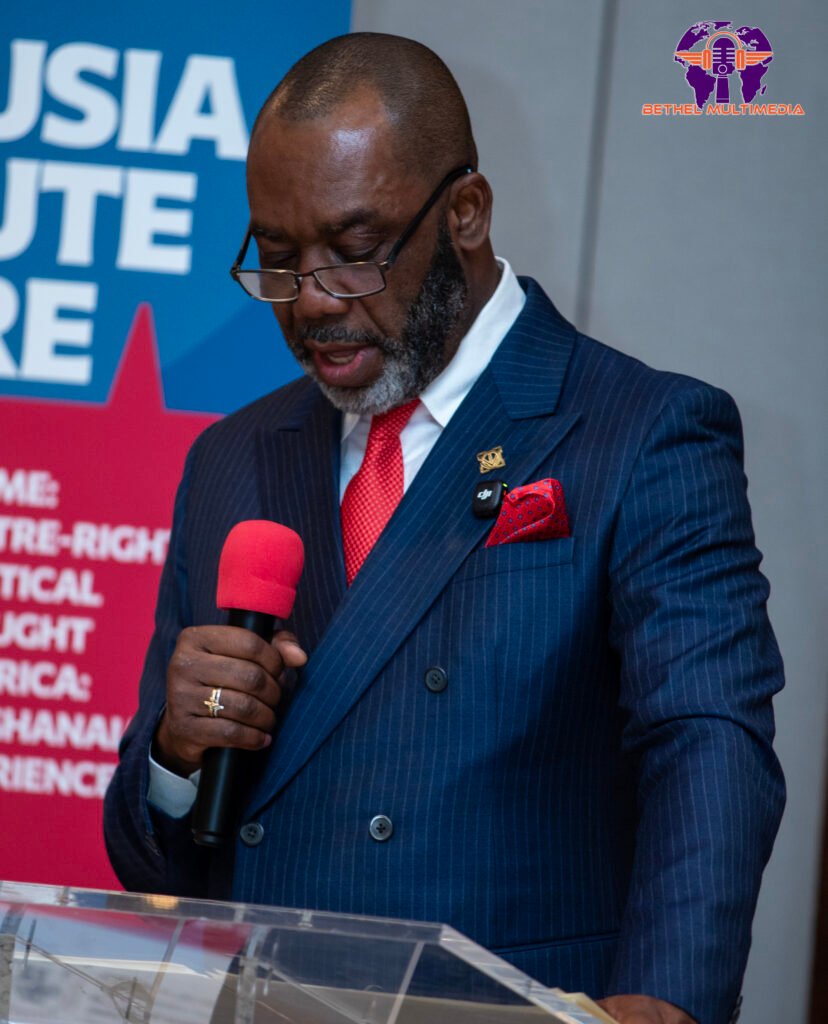
LONDON, United Kingdom – Dr Matthew Opoku Prempeh, a former Minister for Energy and Education, has called for strong constitutional restraints on political power, arguing that such safeguards strengthen democratic leadership rather than hinder effective government.
Delivering the keynote address at the 2026 Busia Institute Lecture at the London Hilton on Park Lane on Sunday, August 9, Dr Prempeh said political power must remain subject to the law regardless of the popularity or perceived integrity of those entrusted with it.
The event, the first international edition of the Busia Institute Lecture, was held under the theme, “Centre-Right Political Thought in Africa: The Ghanaian Experience.”
“Power must be bound by law even when, especially when, it rests in the hands of people we trust,” Dr Prempeh told participants.
“Constitutional restraint is no insult to a good leader. It is the very thing that protects the citizen from the bad one, and protects the good one from himself.”
Lessons from the Second Republic
Dr Prempeh used the lecture to examine the political philosophy of Professor Kofi Abrefa Busia and the experience of Ghana’s Second Republic.
He said one of the significant features of the Busia administration was its acceptance of constitutional limitations on its own authority following Ghana’s return to civilian constitutional rule in 1969.
According to him, the constitutional order restored Parliament, protected fundamental rights, recognised the authority of the courts and made the executive accountable to the legislature.
Quoting Busia, he said: “We are conscious of our fallibility as human beings, and we recognise the need to establish and develop institutions which help to tame the unbridled exercise of power.”
Dr Prempeh said the principle was particularly important because Busia’s Progress Party commanded a substantial parliamentary majority.
He argued that a functioning constitutional democracy must provide legitimate avenues through which disagreement and criticism can be expressed, including Parliament, the judiciary, the media and public debate.
“There can be no true democracy where there is no free expression of opinion in public affairs or criticism of the ruling body,” he quoted Busia as saying.
1972 coup interrupted constitutional order
Addressing the January 1972 military overthrow of the Busia government, Dr Prempeh argued that the coup interrupted Ghana’s constitutional order rather than corrected it.
He said a military takeover could not replace the judgement of the electorate or, by itself, establish that a democratically elected administration had lost its legitimacy.
However, Dr Prempeh cautioned against romanticising the Busia era, saying those who identified with the political tradition had a responsibility to examine its record critically, including its mistakes and controversial decisions.
“Belonging to a tradition does not oblige me to flatter it,” he said.
He identified constitutional government, human dignity, rural equality, private enterprise, social responsibility, education and public-service ethics as some of the principles from the Busia tradition that remained relevant to contemporary Ghana.
“An inheritance is not a monument to be dusted,” Dr Prempeh said. “Its obligation to us is not that we preserve it in memory. Its obligation is that we renew it; in our policy, in our conduct, in our service.”
He said renewing that inheritance required defending the rule of law, expanding economic opportunity, addressing disadvantages facing rural communities and developing political parties capable of sustaining ideas and standards beyond individual personalities.
London holds part of Busia’s story
Dr Prempeh also reflected on the significance of holding the lecture in London, pointing to Busia’s historical connections with Britain.
He recalled that Busia studied at Oxford, sought refuge in Britain during political exile and was receiving medical treatment in Britain when his government was overthrown in January 1972.
“London holds a great deal of Busia’s story: his formation, his refuge, and his exile,” he said.
He described the city as an appropriate setting for a serious examination of Busia’s political and intellectual legacy.
Kufuor stresses liberty and accountability
Former President John Agyekum Kufuor, Life Patron of the Busia Institute for Rural and Democratic Development, said the political tradition associated with J.B. Danquah, K.A. Busia and their successors had historically championed constitutional government, liberty under law, a free press, private enterprise, social responsibility and decentralisation.
Mr Kufuor said any political tradition committed to liberty must also tolerate internal dissent, recognise public office as a temporary trust and protect institutions including Parliament, the judiciary, the media and independent constitutional bodies.
Quoting Busia, the former President said: “Those who have freedom can best preserve it when they use it responsibly and accountably, with concern and consideration for others.”
Democracy goes beyond elections
Chairman of the lecture and Chairman of the Young Executive Forum UK, Bernard Owusu, said democratic governance required more than holding periodic elections.
“Democracy requires listening, persuasion, disagreement conducted with respect, and the patient building of consensus,” he said.
Mr Owusu emphasised the importance of strong institutions, arguing that nations could not depend on either leaders or citizens being perfect.
He also challenged participants to consider how ideas about freedom and rural development should respond to emerging realities including artificial intelligence, digital finance, climate change, youth unemployment and increasing global competition.
Executive Director of the Busia Institute, Dr Anane Agyei, said the London event was organised to provide a platform for examining political thought through evidence, honesty and intellectual independence.
He said the work of the Busia Institute for Rural and Democratic Development was guided by its credo, “Researching the Past. Informing the Present. Shaping the Future.”
According to him, the Institute seeks to connect historical inquiry with contemporary public judgement, leadership and institutional development.
The lecture attracted representatives of the diplomatic community, scholars, policymakers, public servants, members of the Ghanaian and wider African diaspora, students, media practitioners and other invited guests.
Concluding his address, Dr Prempeh said the ultimate relevance of the Busia tradition would be determined not simply by how it was remembered, but by how its principles were demonstrated in contemporary political conduct.
“We must study our history honestly enough to name its wounds,” he said. “We must defend its good name responsibly enough to deserve it. And we must apply its principles intelligently enough to meet the conditions of our own time.”
Bethel Multimedia
